How data is used
The Washington All-Payer Claims Database (WA-APCD) Program transforms healthcare claims data into action. Explore how we use WA-APCD data to inform data-driven decision-making.
Washington HealthCareCompare
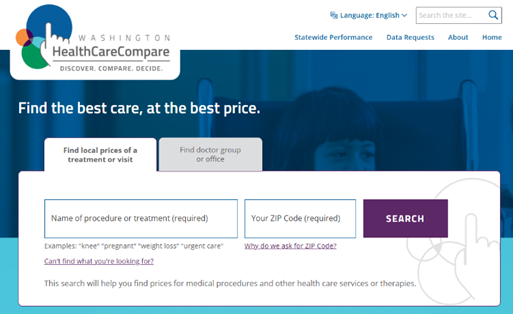
Data from the WA-APCD is made available to the public through Washington HealthCare Compare (WAHCC). WAHCC lets you evaluate the cost and quality of medical services offered by providers in your area. WAHCC has been recognized with a national award for its exceptional ability to convey complex health data clearly.
Visit Washington HealthCareCompare to search for the best care at the best price.
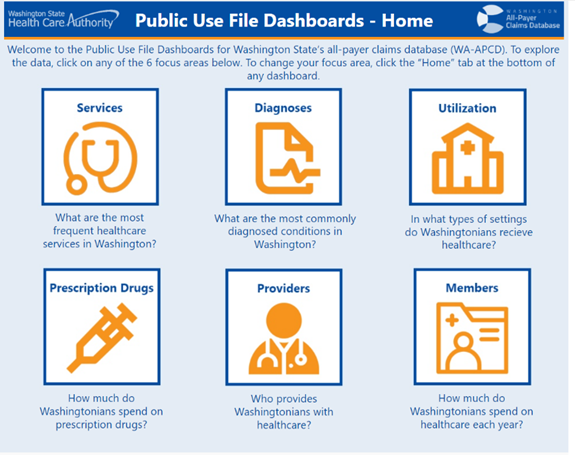
Public use dashboard
The public use dashboard helps people in the healthcare community - from researchers and policy leaders to providers and payers - learn about healthcare services provided in Washington. It includes data on how well services work, and how much they cost. This dashboard is an important tool to help people better understand difference in healthcare quality and use, and to make prices clearer for everyone.
Healthcare transparency is essential to improving the healthcare system so all Washington residents can get better healthcare at lower costs. How is your region doing compared to others?
Visit here to See how well the healthcare system is doing in 9 different regions in Washington.
Visit here to See similar quality measures, but sorted by the type of health insurance people have.
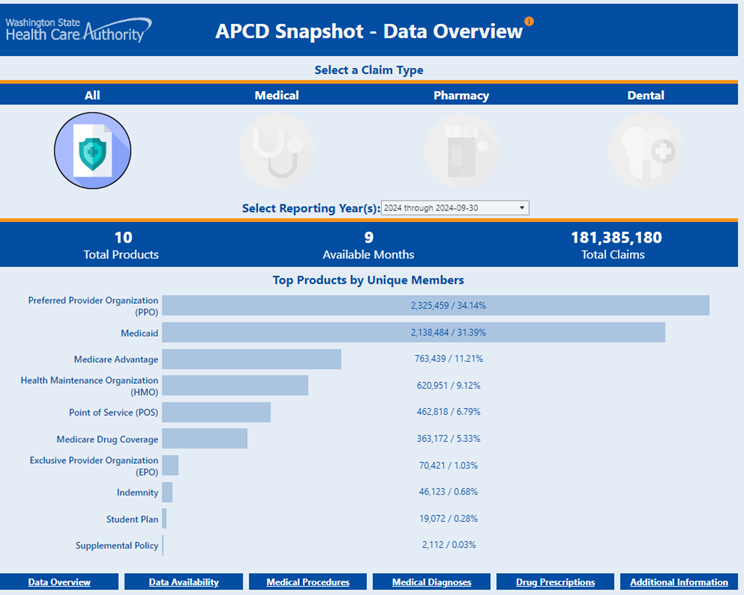
WA-APCD snapshot
The WA-APCD tracks claims data over time for more than 5.5 million Washingtonians, or nearly 70 percent of the population. Our WA-APCD snapshot shows metadata, or data about the data, to researchers, policymakers, and others who have questions about how much data is available, which policy plans are providing it, and how the data has evolved.
WA-APCD data driven-insights
Discover a handful of exciting ways WA-APCD data is being used. These clear, data-driven use cases highlight powerful trends and practical ideas that drive real impact.
Select-WA-APCD use cases
- The state’s Healthcare Cost Transparency Board tracks Washington’s healthcare spending and sets spending goals. The board uses WA-APCD data to find patterns and reasons behind growing healthcare costs and provides recommendations to the state legislature on how to make healthcare more affordable.
- The Office of the Insurance Commissioner (OIC) uses WA-APCD data to meet reporting requirements from the state legislature. OIC updates the states “Surprise Billing Dataset” to help insurers and providers resolving surprise billing disputes as required by the Balance Billing Protection Act. OIC also uses WA-APCD data to analyze how audio-only telemedicine is used, how fertility benefits are provides, and how commercial health plans cover and use ground ambulance services.
Other public reports that use WA-APCD data
- NORC at the University of Chicago created the Physician and Physician Practice Research Database (3P-RD), which captures information on physicians and their practices in 13 states. 3P-RD aims to address gaps in the availability of physician data at the state and market level.
- Researchers at the RAND Corporation used Medicare pricing algorithms to recalculate commercial medical claims. This helped them understand how Medicare and commercial prices compare. Their work supported the fifth release of the public Prices Paid to Hospitals by Private Health Plans report and WA-APCD data is included. This report shows commercial prices as a percent of Medicare prices for hospitals and hospital systems.